
The structure and principle of a brake motor
Publish Time:
2022-02-11
Brake motor Also known as a braking motor, it refers to an ordinary motor with a motor installed at the windward position. Brake motors have a wide range of uses. They can be used to reduce the inertia and impact force generated by the motor during instantaneous shutdown. They can also be used to stop during vertical movement or vertical lifting to prevent the brake motor from slipping down during shutdown. Brake motors can be divided into double-sided brakes and single-sided brakes. Today, I will briefly introduce the structure and principle of the brake motor.
There are many types of brake motors on the market. Some brake motors automatically engage when the power is cut off. At this time, the spring will reset the armature, pressing the friction disc tightly against the motor shaft, which is tightly surrounded by the friction disc, automatically maintaining the load state. Brake motors inevitably wear out during use. Good brake pads are more wear-resistant and maintain better braking force. However, under long-term frequent use, it is still necessary to regularly check the wear condition of the brake motor to avoid braking failure or malfunction. At this time, we can check the brake clearance and adjust the clearance to between 0.4 mm and 0.7 mm. If serious wear occurs, the entire brake assembly needs to be replaced.
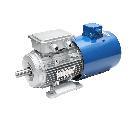
Brake motors and automatic motors can be used with inverters. However, the brake power supply should be connected separately to avoid frequency conversion phenomena. The working principle of the brake motor is relatively simple. There is an electromagnetic brake at its tail end. When it is energized, it will be energized and engaged, and the motor will not be braked. When the motor is de-energized, it will also be de-energized. Then, under the action of the spring, the motor will be braked.
Determination of rotor open-circuit voltage When measuring the rotor open-circuit voltage, the rotor is stationary, the rotor winding is open-circuited, and the starting resistor is disconnected. A rated voltage is applied to the stator winding, and the voltage between each line is measured between the rotor slip rings. For speed-reducing motors with a rated voltage above 500V, the voltage applied to the stator winding can be appropriately reduced. No-load test The no-load test is to apply a three-phase balanced voltage to the stator winding of the speed-reducing motor, so that the speed-reducing motor runs without load. The purpose is to determine the no-load current and no-load loss, and to separate the iron loss and mechanical loss (including wind friction loss) from the no-load loss.
After reading the above content, Brake motor and the structural principles of automatic motors, I hope it can help everyone.
Related News

Copyright © Taizhou Taili Explosion Proof Motor Co., Ltd. Powered by www.300.cn SEO
Friendly Link: Shenzhen Hengtuo Precision Machinery Co., Ltd.