
What are the components of an air brake?
Publish Time:
2021-11-25
AC brake It consists of brake pads, brake arms, brake wheels, and a loose brake. The brake wheel is installed on the rotating shaft of the mechanism as the counter body of the coupling. The symmetrically arranged brake arms are hinged to the fixed part of the frame. Two brake blocks with friction material inside are hinged to the two brake arms respectively. Under the braking force of the loose brake, a pair of brake blocks tightly hug the brake wheel in the radial direction, generating braking force.
When powered on, the core of the AC brake pulls the armature pressure towards the push rod, the push rod pushes the left brake arm to the left, and the main spring is compressed. At the same time, the auxiliary spring, which releases pressure, pushes the right brake arm to the right. The two brake arms separate the brake pads from the brake wheel, allowing the mechanism to move. When the power of the AC brake is cut off, the core loses its magnetism, eliminating the attraction to the armature and releasing the pressure of the armature on the push rod. Under the action of the main spring tension, the two brake arms fold inward together, tightly gripping the brake pads and generating braking force. At the same time, the auxiliary spring is compressed. The braking torque is determined by the main spring force, and the auxiliary spring ensures the loose interval. The braking performance of the AC brake is largely determined by the performance of the loose brake.
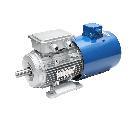
An AC brake is a device that has the function of keeping moving parts (or moving machines) decelerated, stopped, or stationary. Mechanical components that stop or decelerate moving mechanical objects. Commonly known as brakes. Brakes mainly consist of brake pads, brake mechanisms, and operating devices. Some brakes are also equipped with automatic adjustment devices for brake clearance. In order to reduce the braking torque and structural size, brakes are usually installed on the high-speed shafts of equipment, but large equipment with higher safety requirements (such as mine hoists, elevators, etc.) should be installed on the low-speed shafts near the working parts of the equipment.
AC brakes are divided into industrial brakes and automotive brakes. Automotive brakes are further divided into service brakes (foot brakes) and parking brakes (hand brakes). During driving, service brakes (foot brakes) are generally used, which is convenient for slowing down and stopping during forward movement, and it's not just about keeping the car still. If the service brake fails, use the parking brake. After the car is stable, the parking brake (hand brake) should be used to prevent the vehicle from moving forward or backward.
The resistance torque applied to stop or decelerate the working parts of a machine is called braking torque. Braking torque is the basis for the design and selection of brakes, and its magnitude is determined by the style and working requirements of the machine. AC brake The performance of the friction material (brake pads) directly affects the braking process. The main factors affecting performance are the operating temperature and the rate of temperature rise. The friction material should have a high and stable friction coefficient and wear resistance. Friction materials are divided into metallic and non-metallic types. The former often uses cast iron, steel, bronze, powder metallurgy friction materials, etc., while the latter includes leather, rubber, wood, asbestos, etc. The crane brake of an industrial AC brake is both a working device and a safety device for a crane. The AC brake can smoothly stop the rising or falling cargo at the required height, or adjust the speed of rising or falling. In mechanisms such as running or luffing, the brake can smoothly stop the mechanism at the desired position.
Related News

Copyright © Taizhou Taili Explosion Proof Motor Co., Ltd. Powered by www.300.cn SEO
Friendly Link: Shenzhen Hengtuo Precision Machinery Co., Ltd.