
Inspection and troubleshooting of common faults in AC drive motors
Publish Time:
2021-09-09
Due to friction, vibration, aging insulation, etc. AC braking motor Faults will inevitably occur. If these faults are checked, found, and eliminated in time, accidents can be effectively prevented.
Listen to the sound and carefully look for the fault point of the AC braking motor. If a finer "humming" sound is found, there is no high or low change, this is a normal sound. If the sound is rough, a sharp "humming" and "s" sound is a precursor to a fault, and the following reasons should be considered:
The motor (L) vibrates during operation due to loose iron core. Sudden temperature changes will cause the iron core fixing bolts to deform, causing the silicon steel to loosen and produce large electromagnetic noise.
The "rotating" sound produced by the cooling fan is a "rotating" sound, like the "rotating" sound of a drum. This is because the motor suddenly starts, stops, reverse braking, etc., which accelerates the matching of the rotating iron core and shaft. Lightweight equipment can continue to be used, and heavy equipment can be opened for inspection and repair.
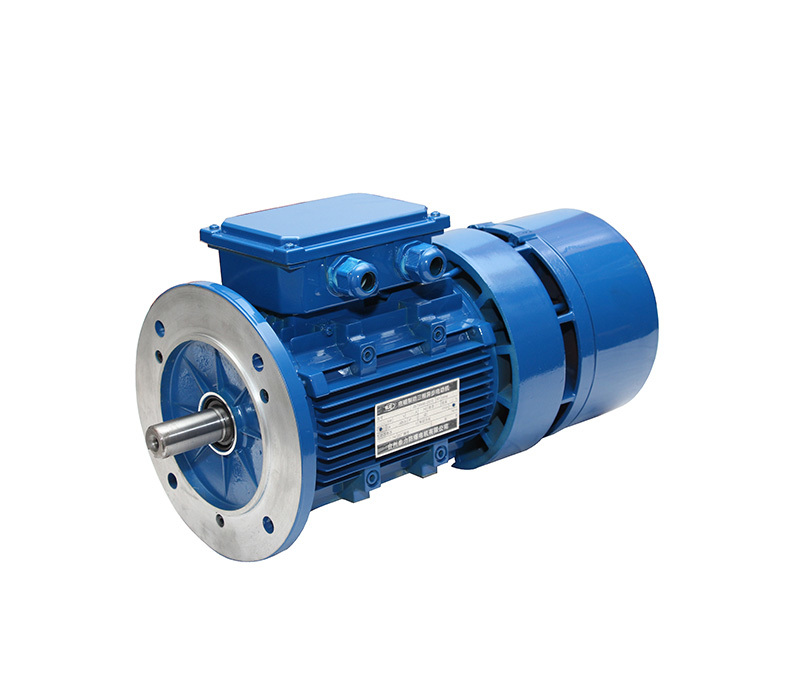
During the operation of the AC braking motor, pay attention to the sound of the bearing. Place one end of the screwdriver on the bearing cover and the other end against your ear to hear the sound changes inside the AC braking motor. Different parts have different faults and different sounds.
Using olfactory analysis, the motor in normal operation has no peculiar smell. If there is a peculiar smell, it will send a fault signal. For example, a burnt smell is produced by the burning of insulation, and smoke will be emitted when the temperature of the AC braking motor rises severely; for example, the smell of burnt oil is mostly due to lack of oil in the bearing, and the oil vapor will evaporate when it is close to dryness.
Use tactile inspection to check for faults. By touching the TV casing with your hand, you can roughly judge the temperature increase. If you touch the motor casing with your hand and feel very hot, the temperature is very high. The cause should be checked, such as: excessive load, excessive voltage, and then the cause of the fault should be eliminated.
AC braking motor performance test
When the AC braking motor starts, because the rotation is stationary, the rotating magnetic field cuts the rotating magnetic field at a relative speed, so that the rotating magnetic field induces a high potential and passes a large current. The current generates magnetic energy that resists the stator magnetic field. In order to maintain the original magnetic flux current that matches the power supply voltage, the stator will also increase, even up to 4 to 7 times the rated current. The large current is called the starting current.
The impact of the AC braking motor starting current may cause the power supply equipment output voltage to fluctuate or trigger overcurrent protection, resulting in failure to start normally. After the AC braking motor starts, as the speed of the AC braking motor increases, the stator current will quickly stabilize. It operates within the rated current range, and a larger power supply is selected to avoid the impact of the starting current, which will cause waste.
An effective way to deal with the impact of starting current is to use AC braking motor Soft start, the speed is achieved by slowly increasing the working voltage of the motor, and gradually reaching the expected set value, which can significantly reduce the starting current of the motor to ensure that the test is carried out normally.
Related News

Copyright © Taizhou Taili Explosion Proof Motor Co., Ltd. Powered by www.300.cn SEO
Friendly Link: Shenzhen Hengtuo Precision Machinery Co., Ltd.