
What are the precautions for electromagnetic brakes?
Publish Time:
2021-08-06
Electromagnetic brake It is a connector that transmits the torsion from the active side to the passive side. It can be freely combined, separated, or braked as needed. Its advantages are small structure, simple operation, quick response, long life, stable use, and easy long-distance control.
Electromagnetic brakes are ideal automated execution elements in modern industry, mainly playing the role of power transmission and motion control in mechanical transmission systems.
Machine parts that stop or decelerate moving objects in a machine. Commonly known as brakes. Brakes mainly consist of brake shoes, brake drums, and operating devices. Some brakes are also equipped with automatic adjustment devices for brake clearance. In order to reduce the braking torque and structural size, electromagnetic brakes are usually installed on the high-speed shafts of equipment, but large equipment with high safety requirements (such as mine hoists, elevators, etc.) should be installed on the low-speed shafts near the working parts of the equipment.
Some electromagnetic brakes are standardized and serialized, and can be manufactured and selected in specialized factories.
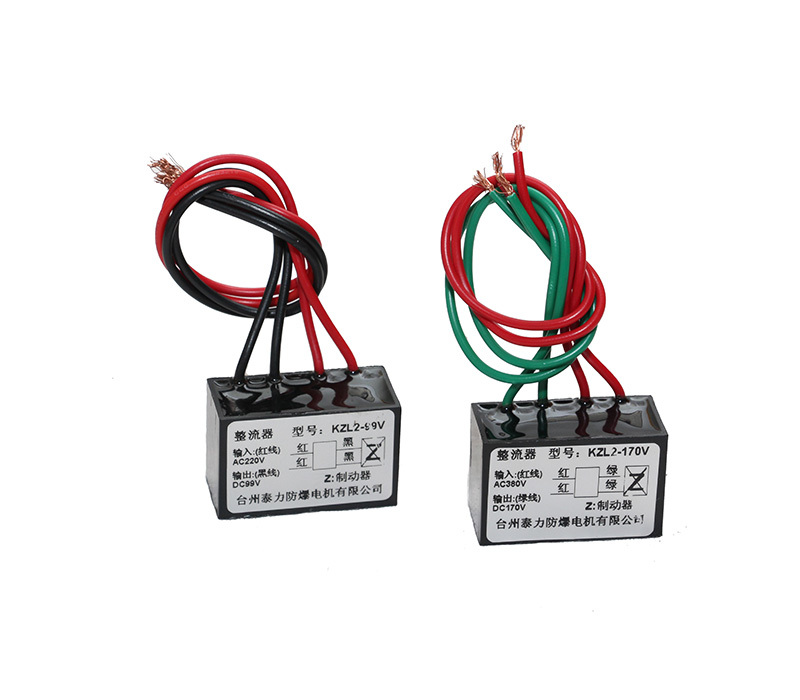
Electromagnetic brakes are mainly consistent with series motors. They are widely used in metallurgy, construction, chemical industry, food, machinery, stage, elevators, ships, packaging and other machinery, as well as braking during power outages.
The resistance torque applied to stop or decelerate machine working parts is called braking torque. Braking torque is the basis for the design and selection of brakes, and its magnitude is determined by the style and working requirements of the machine. The performance of the friction material (brake pads) used for electromagnetic brakes directly affects the braking process, and the main factors affecting performance are the operating temperature and the rate of temperature rise. The friction material should have a high and stable friction coefficient and wear resistance. Friction materials are divided into metallic and non-metallic types. The former often uses cast iron, steel, bronze, powder metallurgy friction materials, etc., while the latter includes leather, rubber, wood, asbestos, etc.
What are the precautions for electromagnetic brakes?
1. Please use the electromagnetic brake in a completely dry and oil-free environment. If the friction parts are contaminated with water or oil, the friction torque will decrease significantly, and the braking sensitivity will also decrease. To avoid this situation during use, please install a cover.
2. When used in dusty environments, please place the brakes in a box. Electromagnetic brakes below 60 kilometers can use a vertical type, and higher models can also be used.
3. Please use the required specifications for the length of the shaft on which the electromagnetic brake is installed.
4. Considering factors such as thermal expansion, please select the axial thrust within 0.2 mm.
5. During installation, please adjust the attraction gap on the electromagnetic brake to within ±20% of the specified value.
6. Please keep the carrier light. Do not put too much pressure on the brake bearings.
7. For assembly screws, please use spring steel plates and retaining agents to prevent loosening.
8. While using Electromagnetic brake the side frame to hold the leads, it is also necessary to use the end plate for firm connection.
Related News

Copyright © Taizhou Taili Explosion Proof Motor Co., Ltd. Powered by www.300.cn SEO
Friendly Link: Shenzhen Hengtuo Precision Machinery Co., Ltd.