
Brake supplier: Some knowledge points about magnetic powder brakes
Publish Time:
2022-07-11
Brake supplier Magnetic powder brakes are believed to be based on the electromagnetic principle, using magnetic powder to transmit torque, and the transmitted torque has a basically linear relationship with the excitation current. Therefore, torque can be easily controlled by changing the excitation current. Under normal circumstances, within the range of 5% to 100% of the rated torque, the excitation current is directly proportional to the transmitted torque.
Brake suppliers believe that when the excitation current remains constant, the transmitted torque is not affected by the differential speed (slip speed) between the driving part and the driven part, meaning there is no difference between static torque and dynamic torque. Therefore, constant torque can be stably transmitted. If this characteristic is applied to tension control, users only need to adjust the excitation current to control and transmit the required torque, thus achieving simple and effective control of coil tension.
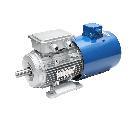
Brake suppliers believe that the torque of magnetic powder brakes needs to be calculated for an appropriate torque, and confirm whether the calculated value is within the controllable range. The torque control range of magnetic powder clutches and brakes is between the rated torque and the product's idling torque * (0.1 ~ 100% of the rated torque). No-load torque: Due to torque loss from internal bearings and seals, even if the excitation current is set to 0A, this no-load torque is usually around 0.1-2% of the rated torque.
Brake suppliers believe that the high speed of electromagnetic powder brakes, whether electromagnetic powder clutches or brakes, needs to be controlled below the permissible speed. In addition, the low speed of general magnetic powder brakes should be controlled above 5-15 r/min, and the input and output speed difference of magnetic powder clutches should be set above 15 r/min. When controlling winding tension, the slip speed of the electromagnetic powder clutch must be greater than 15 rpm. Low slip speed should be controlled at 15-20 rpm. If the low slip speed is too high, it can easily cause the electromagnetic powder clutch to overheat. Using lower speeds can lead to poor internal magnetic powder distribution, resulting in unstable torque performance, or prolonging the time required to reach the specified torque after startup. Large magnetic powder brakes may exhibit low-speed crawling phenomenon when used at low speeds.
Brake suppliers believe that since magnetic powder clutches and brakes are usually used in a continuous slip state, the temperature of magnetic powder clutches and brakes will rise due to the heat generated by slipping. The temperature rise is limited by the heat resistance temperature of the parts used. Therefore, the permissible continuous slip power (permissible heat generation) is specified according to different models. This means that when operated within this permissible range, magnetic powder clutches and brakes can be used stably for a long time. Conversely, if the continuous slip power is exceeded, the electromagnetic powder clutch and brake will be damaged, please be aware.
Brake supplier It is believed that due to the above characteristics, magnetic powder brakes have been widely used in unwinding and winding tension control in related winding processing industries such as papermaking, printing, plastics, rubber, textiles, dyeing and finishing, wires and cables, and metallurgy. In addition, magnetic powder clutches can also be used for soft starting, overload protection, speed regulation, etc. Magnetic powder brakes are often used for dynamometer loading and braking of transmission machinery.
Related News

Copyright © Taizhou Taili Explosion Proof Motor Co., Ltd. Powered by www.300.cn SEO
Friendly Link: Shenzhen Hengtuo Precision Machinery Co., Ltd.